
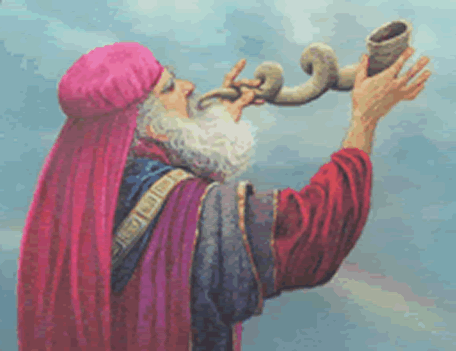
 King Josiah and his Reformation
Biblical Historical Studies:
A Study Prepared for the Feast of Passover
By Pastor J.S. Brooks
If I asked the average Christian or Jew who was the most righteous ancient biblical king, probably 99% would answer either Kings David or Solomon. That's not surprising, because probably few Christians can even name another Old Testament king! Biblical understanding today is woeful. I won't quiz you, except to say that those two kings would be the wrong answer, according to Scripture. Even church ministers have a lack of understanding of the Old Testament. I asked a Baptist pastor friend who the most righteous Old Testament king was. Predictably, his first two guesses were David and Solomon. I gave him a third chance to guess. He said, "Nebuchadnezzar!" I am sure he was joking, but his answer gave us both a hearty laugh, because that was the Babylonian king who conquered and destroyed Jerusalem and its Temple, exiling well over 90% of its inhabitants to Babylon. He was hardly a sterling character! However, I understood his thinking; Nebuchadnezzar came to acknowledge the true God after his seven years of insanity. You can read about it in Daniel 4:31-33. Yet that hardly qualified him to be the most righteous king of the Old Testament. No, not even close!
There was instead another Old Testament king of whom Scripture records, Q: "And like unto him was there no king before him, that turned to the LORD with all his heart, and with all his soul, and with all his might, according to all the law of Moses; neither after him arose there any like him." (2Kings 23:25) There was nobody, no king, more righteous than he in all of Old Testament history; and yet, few believers today know anything about him. Few even know his name! So who was he? King Josiah, Hebrew name Yoshiyahu, meaning "Supported by Yahu" the short form of "Yahuah," the original Hebrew name of God. He was the 16th king of Judah, reigned 31 years from 640 BC to 609 BC, and we read about him in two Old Testament books: 2 Kings 22 & 23, and 2 Chronicles 34 & 35.
It may seem surprising that Josiah was such a noteworthy and righteous king when you consider that his father and grandfather were extremely evil men. His grandfather was the wicked King Manasseh, not to be confused with the Northern Israel tribe of the same name. His father was Amon, who was so hated that he was assassinated when Josiah was only 8 years old. How did Josiah become such a righteous king? As a child he had received a pious education from his mother. How important a godly mother is! Josiah followed the devout teachings of his mother and not the immorality of his godless father. When he ascended the throne, his mother placed him under the guidance of pious men who were faithfully devoted to the law of the Lord, and who turned his heart to the God of their fathers. His mother Jedidah, the daughter of Adaiah, was of Boscath, a city in the plain of Judah, of which nothing else is known. (The city is mentioned, however, in Joshua 15:39). Joshua's character is described succinctly in the phrase, "he turned not aside to the right hand or to the left," from that which was right in the eyes of the Lord, as is enjoined again and again in Deut. 5:29; 17:11, 17:20, and 28:14. He had an unwavering adherence to the law of the Lord. We are not given details about the first years of his reign from age 8. It was Hebrew custom that a boy did not reach the age of maturity until age 13, so he would have been under guardianship until then. Customs die hard: I was also confirmed at age 13 in the Lutheran Church. In Orthodox Judaism, boys are Bar-Mitzvahed, meaning "Son of the Commandments" at age 13, but girls receive Bat-Mitzvah at age 12. Girls have the option to celebrate at 13 if they prefer, but the halachic age remains 12. Why the difference in ages between boys and girls? It is the underlying halachic definition of adulthood; girls mature faster than boys.
We are first told about Josiah's reign during an event that was life-changing for both himself and the nation. The Temple building had been allowed to fall into serious neglect and disrepair, and a collection had been made to fund the restoration. But then something unexpected occurred. We read about it in 2 Kings 22 beginning with verse 3,
2Ki 22:3 And it came to pass in the eighteenth year of king Josiah, that the king sent Shaphan the son of Azaliah, the son of Meshullam, the scribe, to the house of the LORD… Ki 22:8 And Hilkiah the high priest said unto Shaphan the scribe, I have found the book of the law in the house of the LORD. And Hilkiah gave the book to Shaphan, and he read it.
2Ki 22:10 And Shaphan the scribe shewed the king, saying, Hilkiah the priest hath delivered me a book. And Shaphan read it before the king.
2Ki 22:11 And it came to pass, when the king had heard the words of the book of the law, that he rent his clothes. We are not specifically told what portion of Scripture was read to the king that caused him such consternation that he rent his clothes in despair; although there are some indications of a particular likely passage, as we will shortly discuss. Then we read in the next verse…
2Ki 22:12 And the king commanded…
2Ki 22:13 Go ye, enquire of the LORD for me, and for the people, and for all Judah, concerning the words of this book that is found: for great is the wrath of the LORD that is kindled against us, because our fathers have not hearkened unto the words of this book, to do according unto all that which is written concerning us. Scholars debate whether this "book of the law" was a portion of Deuteronomy, the entire Book of Deuteronomy, or the entire Pentateuch. The biblical text does not specify. However, the term "Book of the Law" is usually a synonym for the entire Pentateuch. Yet there are a lot of differing opinions about this. A great many of the laws of Deuteronomy are also found in the Book of Leviticus. Would finding Deuteronomy have sparked such a great Reformation if many of the laws were already known? Alternatively, few people could read in those days, and Josiah may not have been previously made aware of the book or its contents.
We are not told exactly where in the Temple this book was discovered. Josephus thinks that it had been lying in one of the treasure-chambers of the temple. According to Deut. 31:26, the Book of the Law was placed by the side of the Ark of the Covenant, which had also been lost under the idolatrous kings Manasseh and Amon, and came to light again when the temple was being repaired. So the exact identity and hidden location of the book that sparked a revival and reformation remains a mystery. After reading the Book of the Law to the king, a deputation was sent to inquire of the prophetess Huldah concerning it. Why were the prophets Jeremiah and Zephaniah not consulted? Their ministries occurred during this time. Scholars suppose that these two prophets were not in Jerusalem then so they could not be consulted. Not much is known of Huldah. According to the Talmud she was related to Jeremiah [Megillah 14b], and she lived at Jerusalem, "in the second part" or district of the city, the lower city, upon the hill Akra. Her father Shallum was keeper of the clothes, the superintendent over the priests' outfits that were kept in the temple (according to the Rabbins), and the king's wardrobe.
The delegation were given the commission, "Inquire ye of Jehovah for me and for the people and for all Judah (the whole kingdom of Judah & Benjamin) concerning the words of this book of the law that has been found, for great is the wrath of the Lord which has been kindled against us, because our fathers have not obeyed..." We may infer from this that the curses of the law upon the disobedient, found in Deuteronomy 28, had been read to the king. That is a good chapter for us all to read and contemplate. Huldah confirmed the king's dread in prophesying that God would bring judgment upon Jerusalem and its people due to their idolatry and disobedience. All of the punishments promised in the Book of the Law would be fulfilled. Yet there was some good news for the king: because of his faithfulness, the Lord's judgment would be delayed and not fall during his lifetime. We read in…
2Ki 22:19 Because thine heart was tender, and thou hast humbled thyself before the LORD, when thou heardest what I spake against this place, and against the inhabitants thereof, that they should become a desolation and a curse, and hast rent thy clothes, and wept before me; I also have heard thee, saith the LORD.
2Ki 22:20 Behold therefore, I will gather thee unto thy fathers, and thou shalt be gathered into thy grave in peace; and thine eyes shall not see all the evil which I will bring upon this place. It may seem strange that Huldah prophesied that Josiah would go to the grave in peace, because he died in battle. Yet the blessing was that he did not live to witness the horrible destruction of the nation. The Prophet Jeremiah himself lived and prophesied during this time. In a chapter headlined in the King James Bible, "The Broken Covenant," we read:
Jer 11:9 And the LORD said unto me, A conspiracy is found among the men of Judah, and among the inhabitants of Jerusalem.
Jer 11:10 They are turned back to the iniquities of their forefathers, which refused to hear my words; and they went after other gods to serve them: the house of Israel and the house of Judah have broken my covenant which I made with their fathers.
Jer 11:11 Therefore thus saith the LORD, Behold, I will bring evil upon them, which they shall not be able to escape; and though they shall cry unto me, I will not hearken unto them.
Jer 11:13 For according to the number of thy cities were thy gods, O Judah; and according to the number of the streets of Jerusalem have ye set up altars to that shameful thing, even altars to burn incense unto Baal.
Jer 11:14 Therefore pray not thou for this people, neither lift up a cry or prayer for them: for I will not hear them in the time that they cry unto me for their trouble. Wow! Will things get so bad in this land of ours that God will not listen to our own prayers? Are things getting that bad already? Like America today, ancient Judah was in dire need of a spiritual reformation. Jeremiah repeats his charges against the sins of the people in… Jer 25:8 Therefore thus saith the LORD of hosts; Because ye have not heard my words,
Jer 25:9 Behold, I will send and take all the families of the north, saith the LORD, and Nebuchadrezzar the king of Babylon, my servant, and will bring them against this land, and against the inhabitants thereof, and against all these nations round about, and will utterly destroy them, and make them an astonishment, and an hissing, and perpetual desolations.
Jer 25:11 And this whole land shall be a desolation, and an astonishment; and these nations shall serve the king of Babylon seventy years. Jeremiah's prophecy was fulfilled to the letter. Judah suffered a 70 year punishment, from 605 to 536 B.C. The land was desolated, the Temple and houses destroyed, and only a few of the very poorest of the land remained in Palestine.
In 2 Ki. 21:13 the Lord decreed, "I will wipe Jerusalem as a man wipeth a dish, wiping it, and turning it upside down." In other words, Jerusalem was wiped clean! Josiah's Reforms Despite the dire prophecy, King Josiah set about to turn the hearts of the people from their wicked ways, both in obedience to God's Word set out in the Law, and perhaps also in the hope that a sincere revival would turn the Lord's heart and avert the prophesied coming national destruction.
2Ki 23:1 "And the king sent, and they gathered unto him all the elders of Judah and of Jerusalem."
2Ki 23:2 And the king went up into the house of the LORD, and all the men of Judah and all the inhabitants of Jerusalem with him, and the priests, and the prophets, and all the people, both small and great: and he read in their ears all the words of the book of the covenant which was found in the house of the LORD.
2Ch 34:31 And the king stood in his place, and made a covenant before the LORD, to walk after the LORD, and to keep his commandments, and his testimonies, and his statutes, with all his heart, and with all his soul, to perform the words of the covenant which are written in this book.
2Ch 34:32 And he caused all that were present in Jerusalem and Benjamin to stand to it. And the inhabitants of Jerusalem did according to the covenant of God, the God of their fathers. We read, "Jerusalem and Benjamin" not "Judah and Benjamin" because the Assyrians in 701 BC conquered all of Judah except Jerusalem, 46 fenced cities, and exiled them from the land. Historians refer to remaining 7th-century Judah as "a rump state," largely desolate except for a remnant in Jerusalem itself.
2Ki 23:3 And the king stood by a pillar, and made a covenant before the LORD, to walk after the LORD, and to keep his commandments and his testimonies and his statutes with all their heart and
all their soul, to perform the words of this covenant that were written in this book. And all the people stood to the covenant. Why is it important for the text to tell us that Josiah stood by a pillar? There are some scholars who believe that this pillar was the sacred stone anointed with oil by the Patriarch Jacob at Bethel in Genesis 28:18, and that this stone was preserved as a sacred relic of their forefathers. Continuing in…
2Ki 23:4 And the king commanded Hilkiah the high priest, and the priests of the second order, and the keepers of the door, to bring forth out of the temple of the LORD all the vessels that were made for Baal, and for the grove, and for all the host of heaven: and he burned them without Jerusalem in the fields of Kidron, and carried the ashes of them unto Bethel. Kidron was the valley northeast of Jerusalem's old city. The valley lies directly below the Garden of Gethsemane, making it central to the Gospels Passion narrative. It was on the opposite side of the city from the Valley of Hinnom, the famous Gehennah. These two valleys had drastically different symbolism. The Kidron Valley was the valley of kings, worship, and purification; the Valley of Hinnom (Gehenna) was the valley of idolatry, corruption, and the later symbol of hell. The king made a strong statement by burning the idols in Kidron, the place of purification. Josiah then "had their dust carried to Bethel," the ashes of the wooden objects which were burned, and the dust of those of stone and metal which were ground to powder, to defile the idolatrous place of worship at Bethel as the chief seat of idolatry and false worship.
Speaking of ashes, much of the Christian world recently celebrated "Ash Wednesday." A few days later I jokingly asked my Baptist pastor friend, "Did you bring a bucket of ashes to your Wednesday service?" He said, "Oh, no, Baptists do not keep Ash Wednesday, because it is not commanded in the New Testament." I replied, "You are correct, but there are many other rituals that Christian churches keep that are not found in the Bible, including Easter bunnies and Easter eggs, Santa Claus and Xmas trees." He agreed and told me that several years ago these things began to weigh on his mind and he stopped doing them, including Xmas trees. Blessings to him on his own reformation!
But have you ever wondered where Roman Catholic Churches get the ashes they use on Ash Wednesday? According to established church tradition, they take their used Xmas trees, burn them, and save the ashes to use for their ceremony. The Bible calls the decorated fir tree an idol in Jeremiah chapter ten, and it seems very inappropriate, even sacrilegious, to anoint Christians on their foreheads with the ashes from an idol. This is the complete opposite of Josiah's moral actions; he put idol ashes on the wicked, not the righteous! He polluted the ungodly, not the saints. What about Easter? Would Jesus have organized an "Easter Egg Hunt" on the Temple lawn? Yet a multitude of our churches are doing that for Easter, including the Lutheran Church just down the road from our Berkley house of worship. As the popular Christian bracelets say: What would Jesus do? If He would not, should we? WWJD! Verse 5 continues…
2Ki 23:5 "And he put down the idolatrous priests, whom the kings of Judah had ordained to burn incense in the high places in the cities of Judah, and in the places round about Jerusalem; them also that burned incense unto Baal, to the sun, and to the moon, and to the planets, and to all the host of heaven." Astrology is still popular today, even among many Christians.
Many of you are aware, I'm sure, that both our names of the week and names of the month, come from pagan sources. Sunday is the Sun's day. Monday is the Moon's day. Tuesday is Tiw or Tyr's day, the Norse god of war. Wednesday is Woden's day, the chief Norse god. Thursday is named for Thor, the Norse god of thunder. Friday is Freya's day, the Norse god of love. Saturday is the day of Saturn, the pagan god of agriculture. How about the months? Our month names come almost entirely from ancient Rome—rooted in Roman gods, festivals, emperors, and old Latin numbers. January honors Janus, Roman god of beginnings, endings, and doorways. February honors the Roman pagan holiday of Februa, a purification festival held mid-month, and entirely separate from also pagan Valentine's Day. March is named for the Roman god of war, Mars. April honors Aphrodite, the Greek goddess of love, adopted by the Romans as Aprilis. May is named for Maia, the Roman earth goddess of fertility. June is named for Juno, queen of the gods and protector of women and marriage. July is named for Julius Caesar. It was originally called Quintilis, fifth month, but renamed after Caesar's death in 44 B.C. August is named for Augustus Caesar, who claimed many great victories in this month. It was originally named Sextilis, sixth month. September is from the Latin, septem, meaning seven, but it occurs in our ninth month because the Roman year began in March, like the House of Israel. October is from the Latin, octo, meaning eight, but is our tenth month. November is from the Latin novem, meaning nine. December from the Latin decem, meaning ten.
In ancient Israel, King Josiah faced a similar problem. The ten tribe House of Israel's month names came from early nature worship. The two tribe House of Judah was under the great influence of Babylon, even before the Babylonian exile, and adopted the Babylonian names of the months. In fact, we only know a few of the original Hebrew month names because the rest were forgotten through disuse. Only four month names appear in the Old Testamet Tanakh before the Babylonian exile: Aviv the first month; Ziv the second month; Ethanim the 7th month; and Bul the 8th month. (Biblical references: Ex. 13:4; 23:15; 34:18; 1 Kings 6:1; 8:2; 6:38). In addition, archaeologists working at Tel Arad, Israel have rediscovered the ancient name of the Hebrew third month, which was Tsach, forgotten for centuries until recently; you won't find it in your Bible concordance.
Babylonian pagan month names replaced the Hebrew: 1st month Nisan replaced Aviv; 2nd month Iyar replaced Ziv; 3rd month Sivan replaced Tsach; 4th month Tammuz, name of a Mesopotamia pagan deity, Hebrew unknown; 5th month Av, Hebrew unknown; 6th month Elul, Hebrew unknown; 7th month Tishrei repaced Ethanim; 8th month Cheshvan replaced Bul; 9th month Kislev, Hebrew unknown; 10th month Tevet, Hebrew unknown; 11th month Shevat, Hebrew unknown; 12th month Adar, Hebrew unknown.
I won't go through the meaning of the Babylonian names except to comment on the 7th month Tishrei, which name is Chaldean-Babylonian and means "beginning." It corresponds to September-October on our calendar. You might ask, "beginning what?" The answer, according to the venerable Theological Dictionary of the Old Testament, volume 4, p. 232, is "the beginning of the Babylonian calendar year." Babylon's calendar began in the autumn, and the Jews adopted it from them. The original Hebrew calendar had a New Year that began in the Spring, in the month Aviv. Modern theologians steadfastly ignore the distinct differences between the two houses of Israel, and claim that ancient Israel always had two calendars, a Spring religious calendar, and a Fall secular calendar. This is nonsense, an ignorance of historical fact. No nation ever had two different calendars at the same time. How confusing that would be!
You may have noticed that the BYA calendar has eliminated most of the month names in favor of numbered months. Why? It is troubling that the majority of supposed Hebrew months are in reality pagan Babylonian names. This troubled Josiah, too, but he decided to do something about it. He directed the Levitical record-keepers to drop the pagan names and instead number the months. That is why we read this in 2 Chronicles chapter 27, beginning at verse 1:
1Ch 27:1 Now the children of Israel after their number, to wit, the chief fathers and captains of thousands and hundreds, and their officers that served the king in any matter of the courses, which came in and went out month by month throughout all the months of the year, of every course were twenty and four thousand.
1Ch 27:2 Over the first course for the first month…
1Ch 27:4 And over the course of the second month…
1Ch 27:5 The third captain of the host for the third month…
1Ch 27:7 The fourth captain for the fourth month…
1Ch 27:8 The fifth captain for the fifth month…
1Ch 27:9 The sixth captain for the sixth month…
1Ch 27:10 The seventh captain for the seventh month…
1Ch 27:11 The eighth captain for the eighth month…
1Ch 27:12 The ninth captain for the ninth month…
1Ch 27:13 The tenth captain for the tenth month…
1Ch 27:14 The eleventh captain for the eleventh month…
1Ch 27:15 The twelfth captain for the twelfth month…
The Hebrews did the same with numbering of the days of the week. Sunday is called Yom Rishon (יום ראשון), First day; Monday is Yom Sheni (יום שני) Second day; Tuesday is Yom Shlishi (יום שלישי) Third day; Wednesday is Yom Revi'i (יום רביעי) Fourth day; Thursday is Yom Ḥamishi (יום חמישי) Fifth day; Friday is Yom Shishi (יום שישי) Sixth day. Only Saturday has a non-number name: Shabbat (שבת) the Sabbath, Day of Rest. In the Middle Ages the Catholic Church issued a decree to Roman Catholic countries requiring them to similarly eliminate the pagan-named days of the week, and to number them instead. Sunday became "day one," Monday "day two," Tuesday "day three" and so on. However, they found that changing well-established traditions of men is nearly impossible, and today only one Catholic country in the world still numbers their days of the week. That country is…Portugal. Continuing with King Josiah's valiant efforts at national reformation, we read in… 2Ki 23:6 And he brought out the grove from the house of the LORD, without Jerusalem, unto the brook Kidron, and burned it at the brook Kidron, and stamped it small to powder, and cast the powder thereof upon the graves of the children of the people. 2Ki 23:7 And he brake down the houses of the sodomites, that were by the house of the LORD, where the women wove hangings for the grove. The word "sodomites" is the Hebrew "qadeshim," Strongs #6945, meaning "a male devotee by prostitution to licentious idolatry," in other words, homosexuality. It is referenced six times in the Old Testament. This sin is being defended today even by Christians. In Texas, Democratic U.S. Senate candidate James Talarico, a United Presbyterian Church ministerial candidate, defends the "Gay" homosexual agenda. He says that Christ's incarnation is justification for abortion, claiming that the angel gave the Virgin Mary a choice of whether to bear the Messiah or not. This, he claims, is the biblical basis for women to choose whether to abort a baby. No, there was no choice involved; the angel simply proclaimed, "Fear not, Mary: for thou hast found favour with God. And, behold, thou shalt conceive in thy womb, and bring forth a son, and shalt call his name JESUS. He shall be great, and shall be called the Son of the Highest: and the Lord God shall give unto him the throne of his father David: And he shall reign over the house of Jacob for ever; and of his kingdom there shall be no end." (Luke 1:30-33) She was told, not asked. [Ref: Roman Cath. Missals] So good King Josiah strictly enforced God's Laws in the Torah and even put to death idolators.
In 2Kings 19-20, all the houses of the high places that were in the (other) cities of Samaria Josiah also destroyed in the same way as that at Bethel, and offered up the priests of the high places upon the altars, i.e., slew them upon the altars on which they had offered sacrifices. Here are other details concerning what happened in the parallel account in 2Chronicles 34:4… "And they broke down the altars of Baalim in his presence..." Think of that! He not only ordered the idols and altars to be broken down, but he went in person, to ensure it was done; these were the altars [his grandfather] Manasseh had reared up to the idols. It gave Josiah great satisfaction to watch these idols destroyed, and I can imagine that he might have even taken a few swings with a bludgeon himself! 2Ch_34:6-7: "And in the cities of Manasseh...in their ruins round about, there he pulled down the altars." This was in the land of the now-exiled Northern House of Israel. Keil & Delitzsch Bible Commentary explains, "He pulled down pagan altars in the ruins round about; for the land had been deserted since the times of [Assyrian King] Shalmaneser, and its cities were in great part in ruins." The House of Israel, the ten tribes, were exiled nearly completely, and their land was left a deserted ruin, but Josiah marched in and destroyed the remaining altars in that deserted land. The Assyrian kings, who were now masters of the country, might have been displeased at the liberties Josiah took beyond his own territories. But Assyria in its weakened condition in the waning days of its existence, could do little about it. The same Commentary says, "Evidence of Josiah's purge is found in the record preserved in Israelite stamp seals. The seals portraying familiar symbols of fertility gods, sun god and astral deities of earlier periods are replaced in this period with seals that contain only the inscription identifying the individual, with occasional decoration such as pomegranates." As an autumn fruit, pomegranates symbolized the fall Feast of Tabernacles, or Sukkot, another of the seven feasts of Israel. The lily, a Spring flower, symbolized Passover in Hebrew symbolism. Feast of Passover=Pesach & Feast of Unleavened Bread=Chag Matzoth Following the religious reformation, finding of the Law, and repair of the Temple, a grand celebration of the Feasts of Passover and Unleavened Bread took place. We read about this in 2 Chronicles chapter 34. The exact sequential order is not followed either in Kings or Chronicles. But it is clearly recorded in both that the abolition of idolatry began in the twelfth and was completed in the eighteenth year of Josiah's reign. That is, he was 20 y/o when his reformation began, and it was completed six years later when he was 26. The completion of the purge of idolatry was celebrated with one of the grandest Feast of Passover celebrations ever held. It wasn't the largest, because only two tribes, Judah and Benjamin, and a smattering of remnants of the ten tribe House of Israel took part. Assyria in a series of invasions in 732, 721, 701 and 684 BC had attacked and exiled large numbers of both Israel and Judah.
Moving on to 2 Chronicles chapter 35: All the necessary preparations having been completed, and the appointed time having arrived for the Passover, the solemnity was celebrated. The Jamieson, Faucett, & Brown Commentary says, "One remarkable feature in the account is the prominent part that was taken by the Levites in the preparation of the sacrifices; namely, the killing and stripping of the skins, which were properly the peculiar duties of the priests; but as those functionaries were not able to overtake the extraordinary amount of work and the Levites had been duly sanctified for the service, they were enlisted for the time in this priestly employment." Imagine the amount of time and work involved if all the world's 14 million or so Jews converged for Passover at Ezekiel's supposed Millennial Temple! I gave a talk here exposing falsehoods about this titled, "A Temple Tale" that you can find with a quick search on YouTube. It's had over 10,000 views. 2 Chronicles chapter 35 gives us details of the festival. The Israelites who had come kept the Passover on the fourteenth day of the first month, and the Matzoth Festival followed for seven days, from the 15th to the 21st of the same Hebrew month. In 2 Chronicles 35:15 we read, "And the singers ..., were in their place." While the priests and people were busily engaged, the choir was not idle. "They had to sing certain Psalms, namely, the hundred thirteenth to the hundred eighteenth, once, twice, and even a third time, during the continuance of each company of offerors." (Jameson, Faucett, & Brown). Today we dry read the psalms, but originally they were sung by a choir with an orchestra. Some of the psalms in our Bibles even give the names of the hymns, but not the music, unfortunately. 2 Chronicles 35:18 tells us that there was no Passover like to that kept in Israel from the days of Samuel. Instead of "from the days of Samuel," the author of the Book of Kings says, "from the days of the judges who judged Israel" [2Ki. 23:22]. The meaning is the same in both passages, for Samuel concluded the era of the judges. The Jamieson, Faucett, & Brown Commentary adds, "What distinguished it above all preceding solemnities was, not the imposing grandeur of the ceremonies, nor the immensity of the assembled concourse of worshippers; for these, with the exception of a few from the kingdom of Israel, were confined to two tribes. The great majority of the people of the northern kingdom were in exile; but it was the ardent devotion of the king and people, the disregard of purely traditional customs, and the unusually strict adherence, even in the smallest minutiae, to the forms of observance prescribed in the book of the law."
Finally, lets briefly discuss the End of King Josiah and his Reformation: 2 Chronicles 35:20 says, "After all this…"—that is, 13 years after in 609 B.C.— Josiah died in battle with Pharaoh Necho, son of Psammetichus. Josiah and the Israelites had an understandable longtime hatred of the Assyrians, and when Pharaoh and his army marched north from Egypt to aid Assyria in its final struggle with Babylon, Josiah stepped in with his army to prevent the Egyptians from accomplishing their task. Although Judah lost the battle, they may have delayed the Egyptians long enough to ensure the end of the Assyrian Empire. Josiah had disguised himself, but still fell to an enemy arrow. Josiah's reform was short-lived, only a little over a dozen years until he died. His sons undid his reforms, and the first Babylonian attack on Jerusalem was in 605 BC., when Daniel was taken, only four years after Josiah's death. Several of his sons reigned during that short period after he died: Jehoahaz (1 Chronicles 3:15; Jeremiah 22:11). Jehoiakim (2 Chronicles 36:4), and Jeconiah (2 Chronicles 36:8). Jeconiah was then succeeded to the throne by his uncle Mattanyahu, under the name Zedekiah (2 Kings 24:17). Zedekiah was the last king of Judah before the kingdom was conquered by Nebuchadnezzar and the Babylonian captivity ensued. Incredible as it seems, Josiah's Reformation ended only four short years after his death. It was truly a lost reformation, a hope that went astray. The fate of Josiah was unprecedented. No king of Judah had, up to this time, fallen in battle. Hence, the extraordinary character of the mourning (mentioned in Zech. 12:11-14). Historians say that a "Book of Dirges," once existed but is now lost. It was a collection of poems lamenting the passing of righteous leaders including Josiah. Barnes says, "The death of the pious king was deeply lamented by his people. The prophet Jeremiah composed a lamentation for Josiah: "and all the singing-men and singing-women spake lamentations of Josiah unto this day;" in the lamentation which they were wont to sing on certain fixed days, they sung also the lamentation for Josiah. "And they made [these lamentations] an ordinance [a standing custom] in Israel, and they are written in the collection of lamentations, in which, among others, that composed by Jeremiah on the death of Josiah was contained." The entire collection is now gone. Josiah's revival did not last and is now gone as well. Let us learn from this and pray for a new righteous revival and reformation in America!