
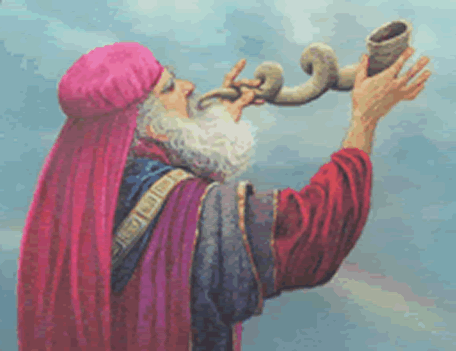
 Evidence Confirming the Egyptian Captivity
Biblical Historical Studies:
A Study Prepared for the Feast of Passover by Pastor J.S. Brooks
In Exodus chapter 12 we read the Lord’s Command to keep the Feast of Passover and Unleavened Bread, and in verse 17 we read, “And ye shall observe the feast of unleavened bread; for in this selfsame day have I brought your armies out of the land of Egypt: therefore shall ye observe this day in your generations by an ordinance for ever.” [Exo. 12:17]
That’s why we are met here today in obedience to Scriptural command. This feast of Unleavened Bread is in honor and in memory of Israel’s Exodus from the Egyptian captivity. But how much do we really know about that important biblical event?
A member of our church congregation asked me such a question recently. She said, “What historical evidence exists that Israel was in slavery in Egypt, and do we have any details about that Egyptian captivity?” The answer is yes to both questions, and since there has been some pioneering recent research on the subject that is not readily known outside of the scholarly community, we’ll take a closer look at this important subject.
What do we know about the Egyptian captivity? The story of the Exodus begins in Chapter 12 verse 33, which reads, “And the Egyptians were urgent upon the people, that they might send them out of the land in haste; for they said, We be all dead men.” This was in response to the tenth Egyptian plague, the death of the firstborn. After ten horrendous plagues, you can understand that the Egyptian populace, if not the king, was anxious for Israel to leave to avoid the possibility of even worse additional plagues! The Israelites left in such a hurry that they took unleavened bread with them; there was no time to let the dough rise.
Then in verses 40 and 41 we read, “Now the sojourning of the children of Israel, who dwelt in Egypt, was four hundred and thirty years. And it came to pass at the end of the four hundred and thirty years, even the selfsame day it came to pass, that all the hosts of the LORD went out from the land of Egypt.” Twice we are told that the Egyptian captivity was 430 years, yet leading scholars believe the exile was actually about 210 years, or about half the biblical statement. The reason for the seeming discrepancy is that during those early centuries Egypt controlled all of southern Canaan including Judea, so that during those early centuries Egypt controlled all of southern Canaan including Judea, so when Abraham arrived in the Promised Land from Mesopotamia he was actually living in what was then a part of Egypt. The actual time that Israel dwelled in the Goshen area of Egypt itself was a little over two centuries.
That said, two centuries is still a long time. You would certainly expect the Israelites to have absorbed a certain amount of Egyptian culture over that period, even if they dwelled by themselves and were somewhat separated from the native people. What actual proof exists?
Let’s begin with a look at the Scriptural evidence. As we read in Exodus 12:17, did you notice a curious thing in that verse? The Lord says, “I brought your armies out of the land of Egypt…all that were able to go forth to war…” Hold on! “Armies”? “War”? Weren’t the Israelites slaves in Egypt? Where did slaves get weapons for an army? We have some things to learn here!
The Hebrew word, tse’baah, Strongs #6635, appears 484x, and is defined by Strong’s Concordance as “a mass of persons especially regularly organized for war.” We see this in the usage of the word.
Gen. 28:22, “Chief Captain of the host/tsebaah.”
Exo. 6:26, “These are that Aaron and Moses, to whom the LORD said, Bring out the children of Israel from the land of Egypt according to their armies/tsebaah. H6635.
Exo. 7:4, “But Pharaoh shall not hearken unto you, that I may lay my hand upon Egypt, and bring forth mine armies/tsebaah, and my people the children of Israel, out of the land of Egypt by great judgements.” Note “the armies and the people.”
In Numbers 31:27-28 it is translated “battle” in each of those verses. This is not the popular picture of Israel we have as a weak, frightened group of slaves fleeing in fear.
Were they actually armed with weapons? Exodus 13:18 AV, “But God led the people about, through the way of the wilderness of the Red Sea: and the children of Israel went up harnessed out of the land of Egypt.” Strongs H2571, chamush [khaw-moosh] “able-bodied soldiers, armed men.”
English Std. Version: “Israel went up out of the land of Egypt equipped for battle.”
Geneva Bible 1587: “the children of Israel went up armed out of the land of Egypt.”
Rotherham: “the sons of Israel went up armed, out of the land of Egypt.”
Complete Jewish Bible: “The people of Isra’el went up from the land of Egypt fully armed.”
The Bible Knowledge Commentary disagrees, however, with this understanding.
“Armed for battle probably means organized for march rather than equipped with armor, bows, and arrows for warfare.” Barnes Commentary takes the opposite view: “There is not the least indication that the Israelites had been disarmed b the Egyptians, and as occupying a frontier district frequently assailed by the nomads of the desert they would of necessity by accustomed to the use of arms. Compare Exodus 1:10.”
Exo. 1:10, “Come on, let us deal wisely with them; lest they multiply, and it come to pass, that, when there falleth out any war, they join also unto our enemies, and fight against us, and so get them up out of the land.”
While there is some disagreement on that issue, there is no question that the Bible indicates that Israel suffered a period of oppression in Egypt.
Exo. 1:11-14, “So they set taskmasters over them to oppress them with burdens; and they built garrison cities for Pharaoh: Pithom and Ramesses.” These are believed to have been a large complex of storage buildings to supply the Egyptian temple worship. Verses 12-15: “But the more they made them suffer, the more they increased and spread out, so that the Egyptians came to dread the Israelites. The Egyptians ruthlessly imposed upon the Israelites the various labors that they made them perform. Ruthlessly they made life bitter for them with harsh labor at mortar and bricks and with all sorts of tasks in the field.”
The language of these verses, sivlot/burdens; levenim/bricks; avodah/labor, fits with the detailed description of Israelite slavery in the Book of Exodus.
The Bible says that the Israelites were “oppressed,” Hebrew, lachats [la’khats], Strong’s #3906, “distress, oppression, affliction.”
Exodus 3:9, “Now therefore, behold, the cry of the children of Israel is come unto me: and I have also seen the oppression/lachats wherewith the Egyptians oppress/lachats them.
Deut. 26:7, “And when we cried unto the LORD God of our fathers, the LORD heard our voice, and looked on our affliction, and our labour, and our oppression/lachats.
Egypt is called “the house of bondage” in Exodus 13:3. The Complete Jewish Bible translates this, “the abode of slavery.”
Curiously enough, there are other passages of Scripture that seem to indicate that there was a time when life in Egypt was not quite that bad. A number of passages refer to Israel’s status in Egypt as “sojourners,” without mention of bondage or oppression: Exodus 22:20 says, ‘You shall not wrong or oppress a sojourner, for you were sojourners in the land of Egypt.”
You might have expected a statement to “not oppress foreigners despite the fact that you wre oppressed by the Egyptians,” but no such statement appears. A sojourner is a term with no negative connotations, as simply dwellers in the land, colonists. In addition a number of Israelites seem to have had “Egypt nostalgia.” We read this in Exodus 16:
Exo. 16:2. “And the whole congregation of the chi8ldren of Israel murmured against Moses and Aaron in the wilderness.”
Exo. 16:3. “And the children of Israel said unto them, Would to God we had died by the hand of the Lord in the land of Egypt, when we sat by the flesh pots, and when we did eat bread to the full; for ye have brought us forth into this wilderness, to kill this whole assembly with hunger.”
This melancholy reminiscence continued into the book of Numbers:
Num. 11:4. “And the mixt multitude that was among them fell a lusting: and the children of Israel also wept again, and said, Who shall give us flesh to eat?”
Num. 11:5. “We remember the fish, which we did eat in Egypt freely; the cucumbers, and the melons, and the leeks, and the onion, and the garlick.”
Num. 20:5. “And wherefore have ye made us to come up out of Egypt, to bring us in unto this evi place? It is no place of seed, or of figs, or of vines, or of pomegranates; neither is there any water to drink.” Rotherham translates it, “this wretched place.”
This brings up another interesting point related to the Exodus from Egypt:
Numbers 11:4 we just read refers to the trouble caused by “the mixed multitude.” Who were they? The Amplified Bible calls them, “the rabble who followed Israel from Egypt,” giving them a very negative connotation. In contrast, Miles Coverdale 1535 translates, “the common sorte of people yet was amoge them.” The Complete Jewish Bible says, “the mixed crowd that was with them.” The Hebrew word is aspesuph, Strongs #628, “gathered up together, a promiscuous assembly.” That tells us nothing about who they were. One British-Israel writer in England apparently believes that they were Black Libyan natives. It is more likely that they were Semitic Hyksos who were also expelled from Egypt with the Israelites. Why would Libyans want to go to Palestine, where they had no heritage or relations? In contrast, the Hyksos homeland was Palestine.
Manetho, a famous Egyptian priest and historian from the third century, B.C., in his book Aegyptiaca, identifies the Israelites with the Hyksos, known as the Shepherd Kings. The term Hyksos derives from the Egyptian term Heka-chasut (Hq3-h3swt), meaning “foreign kings,” and refers to the Asiatic rulers of Lower (i.e. northern) Egypt bordering the Mediterranean Sea during the Second Intermediate Period (Egypt’s 15th dynasty; c. 1674-1535 B.C.). Many of these rulers had recognizably Semitic names, including one named Jacob (Yaqub-Hor).
According to ancient historian Manetho, the Hyksos surrendered to the Egyptians in return for safe passage back to Canaan. In fact, archaeologists have documented that at least one town in Judea, Sharuhen (Joshua 19:6) was founded by exiled Hyksos from Egypt. (SDA Commentary 1:145)
This may provide the answer as to the identity of the Pharaoh who “knew not Joseph.” If the Hyksos Pharaohs had been favorable to the Israelites, their replacement by the non-Semitic Theban kings that conquered all of Egypt would have changed Israel’s situation drastically. We are given this clud in Exodus chapter one, beginning at verse 6. (Reading from AMP translation):
Exo. 1:6. “Then Joseph died, and all his brothers and all that generation.
Exo. 1:7. “But the descendants of Israel were fruitful and increased abundantly; they multiplied and grew exceedingly strong, and the land was full of them.
AMP Subheading: Pharaoh Oppresses Israel.
Exo. 1:8. “Now a new king arose over Egypt who did not know Joseph.”
Exo. 1:9. “He said to his people, Behold, the Israelites are too many and too mighty for us [and they outnumber us both in people and in strength.]”
Exo. 1:10. “Come, let us deal shrewdly with them, lest they multiply more and, should war befall us, they join our enemies, fight against us, and escape out of the land.”
Exo. 1:11. “So they set over [the Israelites] taskmasters to afflict and oppress them with [increased] burdens. And [the Israelites] built Pithom and Rameses as store cities for Pharaoh.”
Exo. 1:12. “But the more [the Egyptians] oppressed them, the more they multiplied and expanded, so that [the Egyptians] were vexed and alarmed because of the Israelites.
Exo. 1:13. “And the Egyptians reduced the Israelites to severe slavery.”
Exo. 1:14. “They made their lives bitter with hard service in mortar, brick, and all kinds of work in the field. All their service was with harshness and severity.
Who was the new Pharaoh who “knew not Joseph?” It may have been Pharaoh Ahmose 1 who we know defeated and expelled the Hyksos and thereafter may have made Israel’s life in Egypt unbearable.
The Second question to discuss is “What historical evidence exists that Israel was in slavery in Egypt?”
Three types of proofs exist: Egyptian words in Hebrew; Egyptian religious influence on the Hebrews; and Egyptian customs adopted by the Hebrews.
PROOF #1: EGYPTIAN WORDS AND PLACE-NAMES IN HEBREW.
There are at least three types of proofs of the Egyptian sojourn that we can document. The first is the existence of Egyptian words and place-names that were adopted into the Hebrew language:
One prevalent example is the Egyptians word, amu, meaning people or nation, which became a common word in Hebrew: am meaning people, and ami (my people). This word appears 1868 times in the Old Testament Hebrew, a very common word. Some examples include…
Exo. 3:7. “And the LORD said, I have surely seen the affliction of my people/ami which are in Egypt, and have heard their cry by reason of their taskmasters; for I know their sorrows;
Exo. 3:10. “Come now therefore, and I will send thee unto Pharaoh, that thou mayest bring forth my people/ami the children of Israel out of Egypt.
Exo. 3:12. “And he said, Certainly I will be with thee; and this shall be a token unto thee, that I have sent thee: When thou hast brought forth the people/am out of Egypt, ye shall serve God upon this mountain.”
Exo 3:21. “And I will give this people/am favour in the sight of the Egyptains: and it shall come to pass, that, when ye go, ye shall not go empty.”
One last example of this: Exo. 1:22, “And Pharaoh charged all his people/am saying, Every son that is born ye shall cast into the river, and every daughter ye shall save alive. That command by Pharaoh led to the story of Moses in Exodus chapter 5. The name Moses (literally, “Mosheh”) means “a drawing out") Strongs #4872). Scholars have determined that his name has an Egyptian derivation.
GOSHEN:
The Israelites named the region of Egypt they settled “Goshen,” after an area in the southern part of the territory of Judah that may have reminded them of home. Strong’s Concordance says, “Probably of Egyptian origin. The residence of the Israelite in Egypt, also a place in Palestine.” The Egyptian Goshen is described this way:
Gen. 47:6. “The land of Egypt is before thee; in the best of the land make thy father and brethren in the land of Goshen let them dwell: and if thou knowest any men of activity among them, then make them rulers over my cattle.”
Gen. 47:27. “And Israel dwelt in the land of Egypt, in the country of Goshen; and they had possessions therein, and grew, and multiplied exceedingly.
There was also an area in Canaan called Goshen, which site has not been located. Here is what the Bible says about th Goshen in southern Canaan:
Josh. 11:15. “As the Lord had commanded Moses His servant, so Moses commanded Joshua, and so Joshua did; he left nothing undone of all that the Lord commanded Moses.
Josh. 11:16. “So Joshua took all that land: the hill country, all the South, all the land of Goshen, the lowland, the Arabah [plain], the hill country of Israel and its lowland,”
Josh. 10:41 also speaks of “all the land of Goshen,” so it must have been a region rather than just a village.
Succoth:
Another example of word transfer: The Israelites named the region of Egypt they settled, “Succoth,” booths; [Strong’s #5523] after 3 locations of that name in Canaan. They dwelled in tents or booths before building any houses.
The town of Succoth figures in the story of Jacob in:
Gen. 33:17. “And Jacob journeyed to Succoth, and built him an house, and made booths for his cattle: therefore the name of the place is called Succoth.”
The Egyptian Succoth has a prominent place in the story of the Exodus:
Num. 33:5. “And the children of Israel removed from Rameses, and pitched in Succoth.”
Num. 33:6. “And they departed from Succoth, and pitched in Etham, which is in the edge of the wilderness.”
Even more proofs:
Professor Richard Elliott Friedman, in his study, “The Historical Exodus,” documented that some of the Levites after the captivity retain Egyptian names: Hophni, Hur, Merari, Mushi, two people named Phinehas, and of course Moses, from an Egyptian word meaning “to draw out.”
These language proofs make it very difficult to deny that there was more than a casual interaction between Israel and the land of Egypt.
-------------------------------------------------------------------------------------------------------------------------------------------------------------------
PROOF #2: Egyptian religious influence on the Hebrews:
The Israelite adopted the worship of man foreign gods, as can be amply seen in the classic book, The Two Babylon, by Alexander Hislop, originally published in 1916 and has gone through several reprintings. There is a section of Egyptian religion, from which I quote this: “The ordinary way in which the favourite Egyptian divinity Osiris was mystically represented was under the form of a young bull or calf—the calf Apis—from which the golden calf of the Israelites was borrowed.” (p. 45). You know the story of the golden calf worshipped by the Israelites, which they adopted from the religion of Egypt.
In a famous and very heartrending passage in Exodus 32:8 we read, “They have turned aside quickly out of the way which I commanded the: they have made them a molten calf/egel (Strongs #5695), and have worshipped it, and have sacrificed thereunto, and said, These be thy gods, O Israel, which have brought thee up out of the land of Egypt.”
The people were so sinful and apostatized that they credited the gods of Egypt as their divine deliverers. The false calf worship did ot go away, for the Prophet Ezekiel centuries later reported:
Ezek. 20:7. “Then said I unto them, Cast ye away every man the abominations of his eyes, and defile not yourselves with the idols of Egypt: I am the LORD your god.”
Ezek. 20:8. “But they rebelled against me, and would not hearken unto me: they did not every man cast away the abominations of their eyes, neither did they forsake the idols of Egypt: then I said, I will pour out my fury upon them, to accomplish my anger against them in the midst of the land of Egypt.
Why would there be such deep, penetrating and pervading attachment to the idols of Egypt if Israel had never had any contact with the country? They were very deeply infused with Egyptian customs, religion and gods—more than people today realize.
Another good example of Egyptian religious influence is seen in a recent article in the New York Daily Post Newspaper, April 14, 2025, authored by historian Ben Cost, which reads: “Interestingly, the [Egyptian] stronghold’s founder [Pharaoh] Akhenaten is often viewed as a disruptor, notably breaking from the civilization’s polytheistic tradition in favor of solely worshipping the sun god Aten—the pharaoh’s name notably means ‘beneficial to Aten’.”
Here is an example where the word, Aten or Aven, the Egyptian sun god, became a part of the Hebrew language and given the meaning “iniquity,” “vanity,” “idols” or “nothings” in Hebrew. The word, Aven (Strongs #205), appears 79 times in the Old Testament, with a variety of related meanings. As an example…
Jer. 4:14. “O Jerusalem, wash thine heart from wickedness, that thou mayest be saved. How long shall thy vain/aven thoughts lodge within thee? Worship of idols is vain, it accomplishes nothing!
Amos 5:5. “But seek not Bethel, nor enter into Gilgal, and pass not to Beersheba: for Gilgal shall surely go into captivity, and Bethel shall come to nought/aven.” Here aven is translated “nought” because idols are nothings, no gods.
Isaiah 66:3b. “…he that burneth incense, as if he blessed an idol/aven. Yea, they have chosen their own ways, and their soul delighteth in their abominations.” An idol is an aven.
Isaiah 59:7. “Their feet run to evil, and they make haste to shed innocent blood: their thoughts are thoughts of iniquity/aven; wasting and destruction are in their paths.”
----------------------------------------------------------------------------------------------------------------------------------------------------------------------
PROOF #3: Egyptian customs adopted by Hebrews.
Refusal to Sit with Foreigners at Table.
When the brothers show up in Egypt for the second time, Joseph arranges for them to dine with him at his house, and we read in Genesis 43:32 (Amp. Version):
“And [the servants] set out [the food] for [Joseph] by himself, and for [his brothers] by themselves, and for those Egyptians who ate with him by themselves, according to the Egyptian custom not to eat food with the Hebrews; for that is an abomination to the Egyptians.”
The famed Greek historian Herodotus visited Egypt (around 450 BC). Herodotus reports in epic detail on the strict exclusiveness of Egyptian table customs, which allowed no sharing of meals with foreigners due to the foreigners’ presumed consumption of cows, sacred to the Egyptians.
This is what Herodotus says (Histories 2:41): “And all the Egyptians without distinction reverence cows far more than any other kind of cattle; for which reason neither man nor woman of Egyptian race would kiss a man who is a Hellene on the mouth, nor will they use a knife or roasting-spits or a caldron belonging to a Hellene, nor taste of the flesh even of a clean animal if it has been cut with the knife of a Hellene.”
The Jews adopted this separation from foreigners. The Roman historian Tacitus (56 – c. 117 A.D.) says in his history, chapter 5.1.5: “They (Jews) regard the rest of mankind with all the hatred of enemies. They sit apart at meals, they sleep apart, and though, as a nation, they are singularly prone to lust, they abstain from intercourse with foreign women.”
The Apostle Paul refers to the sitting apart at meals and criticizes his fellow Jew, Cephas, saying in Galatians 2:11-13: “But after they came, he drew back and kept himself separate for fear of the circumcision faction. And the other Jews joined him in this hypocrisy…”
Did the Jews get this custom from the Bible, or from Egypt? The biblical Torah states, “You shall not abhor an Egyptian, for you were a sojourner in that land.” (Deut. 23:8).
Conclusion:
The land of Goshen in Egypt was home to the Israelites for more than two centuries. Why is there not more archaeological and written source documents? Goshen was a somewhat lush, wet, rich pastureland, one of the few places in Egypt that would support shepherding sheep. It therefore was not an area conducive to stone monuments of fragile documents written on papyrus, which decays rapidly.
As I briefly mention, the famous and well-respected ancient Egyptian historian, Manetho, documented not only that Israel had indeed dwelled in Egypt as captives but that they were linked to the Semitic Hyksos, the Shepherd Kings. This is another important subject that I would like to discuss further in a future lecture.